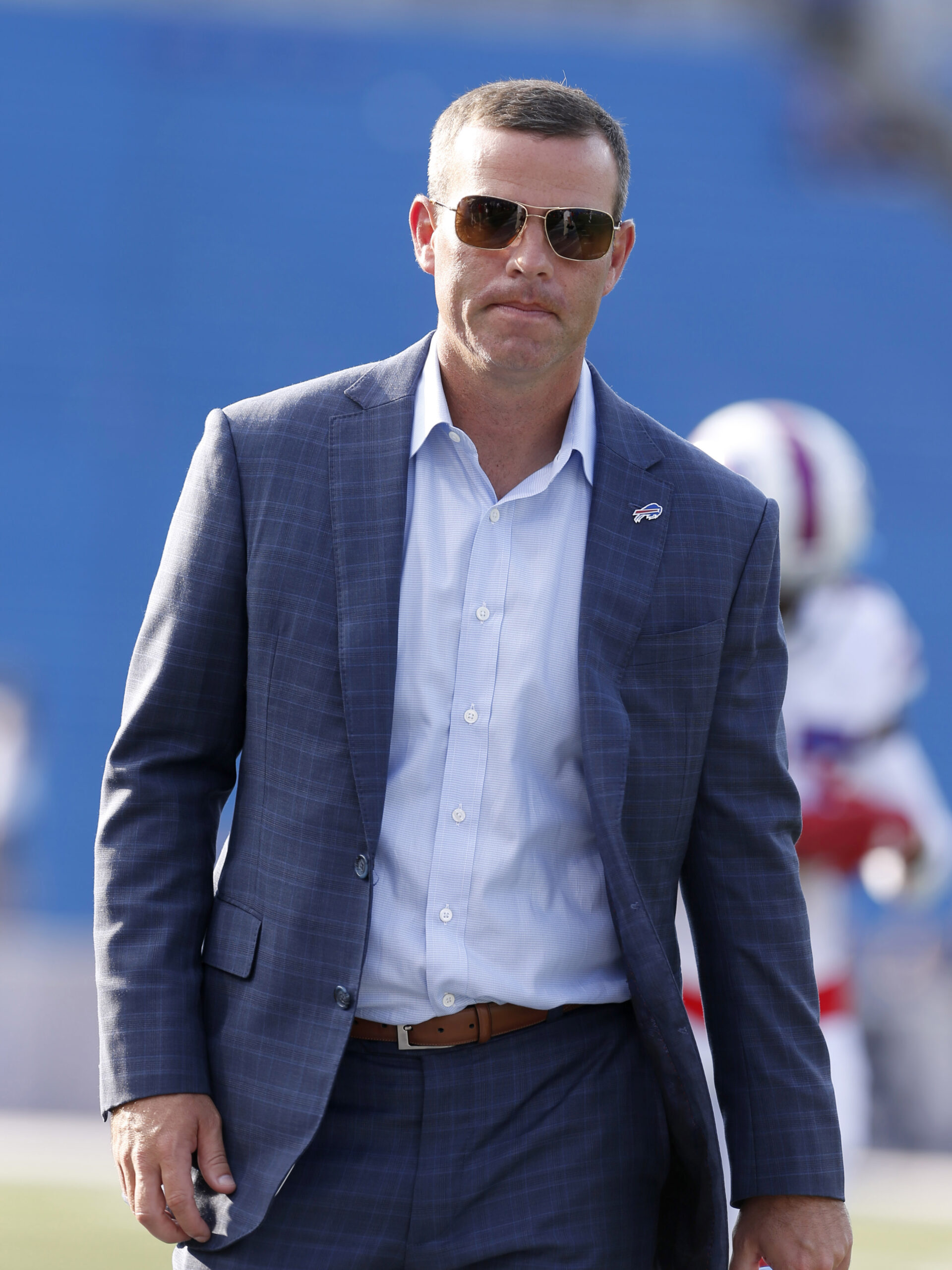
The 2026 offseason may be the most consequential of Brandon Beane’s tenure. The Bills are over the cap, transitioning defensively, and still searching for the final pieces needed around Josh Allen to bring them back to dominance in the AFC.
In our last article, we broke down how the Bills defensive roster would need to shift and which players would need to be utilized in new ways. Today we’ll break down the Salary Cap and project how to make space for the Bills to improve the roster through Free Agency.
Making Room on the Salary Cap
Currently, according to spotrac.com the Bills are 15 million dollars over the Salary Cap, so for them to do anything in Free Agency, they will need to clear Cap space by either restructuring, extending, or releasing their current players. The proverbial can will need to be kicked down the road, and familiar faces will be hitting the road, but we will welcome new players into the new stadium in August.
Conversions
In this simulation, we pull the easiest lever, converting Josh Allen‘s base salary into a signing bonus. Josh gets an big check, and the Bills get to spread the bonus number across the rest of the contract
- Josh Allen – restructure – +12.16mil
Extensions
There has been a lot of talk about saying goodbye to offensive “McDermott” locker room guys, however, continuity is a value the Bills are a proponent of, so in this simulation extensions are the path the Bills navigate to free some cap space and get ahead of contract extensions for young productive players. (Note: We used market value extensions to simplify the process and not doctor the results in the Bills benefit)
- Dion Dawkins – extend – 3 yrs/63.6 mil – +12 mil
- Dawson Knox – extend – 2 yrs/9.427mil – +12.8 mil
- O’Cyrus Torrence – extend – 3 yrs/39.2 mil – -.15 mil
Releases
A few players have disappointed and the Bills will be ready to move on and start fresh, while creating cap space to bring new players in to upgrade the production at those positions.
- Curtis Samuel – release – +6 mil
- Taylor Rapp – release – +3 mil
- Dane Jackson – release – 1.2 mil
Total Cap Space after Cap Moves: 30 mil
The Bills’ Free Agents
The Bills currently have 22 pending free agents that they will need to make decisions about whether to allow them to hit free agency, or come to an agreement on terms for them to return to the Bills in 2026.
Returning
- Brandin Cooks – 1 yr/2.9 mil
- Mitchell Trubisky – 1 yr/2.8 mil
- Shaq Thompson – 1 yr/2.3 mil
- Mitch Wishnowsky – 1 yr/1.2 mil
- Gabe Davis – 1yr/1.2 mil
Hitting Free Agency
- Joey Bosa
- DaQuan Jones
- Connor McGovern
- Larry Agunjobi
- Matt Milano
- A.J. Epenesa
- David Edwards
- Tre’Davious White
- Damar Hamlin
- Reggie Gilliam
- Cam Lewis
- Matt Prater
- Jordan Poyer
- Jordan Phillips
- Sam Franklin
- Darnell Savage
- Ryan Van Demark
Total Cap Space after signing their own : 23.8 mil
Free Agent Additions
The Bills are prioritizing defensive additions in this projection, giving Jim Leonhard new weapons to execute his aggressive 3-4 scheme, and filling key losses to the offseason. In selecting targets, we sought to achieve the following goals:
- add defensive front flexibility
- add veteran stability at corner
- fill the gaps left by the departing OL free agents
- preserve draft flexibility
Offensive Additions
- C Ethan Pocic – 3yr/31.8 mil : -4.5 mil cap hit
- WR Jahan Dotson – 1yr/2.6 mil : -2.6 mil cap hit
Defensive Additions
- NT Jonathan Franklin-Meyers : 2yr/15.7 mil – -3.9 mil cap hit
- S P.J. Locke – 1yr/3.5 mil : -3.5 mil cap hit
- ILB Leo Chenal – 3yr/13.9 mil : -2.6 mil cap hit
- ILB Jack Sanborn – 1yr/2.1 mil : -2.1 mil cap hit
- CB Avonte Maddox – 1yr/1.6 mil : -1.6 mil cap hit
- CB Chidobe Awuzie – 1yr/1.3 mil : -1.3 mil cap hit
- CB Fabian Moreau – 1yr/1.2 mil : -1.2 mil cap hit
These moves would give the Bills 9.3 mil in cap space, enough to cover the incoming draft class and still have 6.1 mil in cap space to go into the summer to sign additional free agents as there are cuts from other teams and as needs arise.
Obviously, it takes two to tango when it comes to contract negotiations, but given the fit and the relationships most of these players have with the current Bills coaching staff, this seems like a realistic way to build the Bills 2026 roster up to the end of Free Agency, so that the Bills can focus on taking the best available players in the draft.
If executed, this type of approach leaves the Bills cap-compliant, defensively retooled, and flexible entering the draft — without mortgaging the future.
Next, we’ll dig into positional needs and targets in the 2026 NFL Draft.
While waiting for that, maybe read our deep dive into new WR Coach Drew Terrel, and see why he could be the key to unlocking the potential of the current WR roster.